
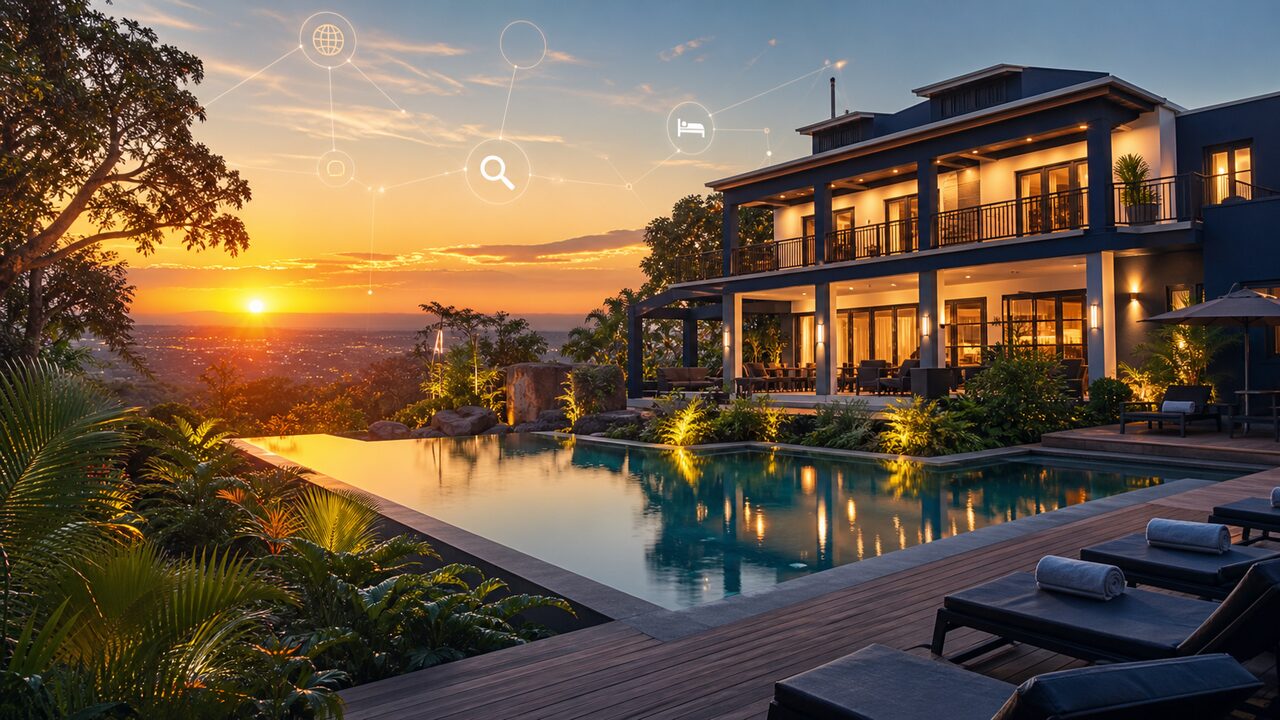
SEO for Hotels in Zimbabwe - More Direct Bookings From Google
Every night a room sits empty costs you money. Every booking that comes through an OTA costs you commission. SEO is how you fill more rooms at better margins.
A business traveller in Johannesburg needs a hotel in Harare for next Tuesday. A couple in London is planning a Victoria Falls trip and wants somewhere to stay nearby. A conference organiser is looking for venue options in Bulawayo. All three reach for Google. Within minutes they have a shortlist, and the properties that appear are the ones that get the booking.
If your hotel does not show up in those searches, it does not matter how beautiful the rooms are or how good the breakfast is. You simply were not in the running. This guide is written specifically for hotel owners, guest house operators and accommodation managers across Zimbabwe who want to change that equation.
Discuss SEO for Your Hotel
Want more direct bookings and less OTA dependency? Speak to Craig Riley directly.
The OTA Problem Every Hotel Owner Understands
If you run a hotel in Zimbabwe, you already know the deal. Booking.com, Expedia, TripAdvisor and similar platforms send you guests, but they take a commission on every single reservation. For many properties that commission runs between 15 and 25 percent of the room rate. On top of that, they own the guest data and the relationship, making it harder for you to build loyalty and encourage repeat stays.
OTAs are not the enemy. They serve a useful purpose, particularly for international travellers who trust the platform's review system and booking guarantee. But over-reliance on them erodes your margins and leaves your business vulnerable to their algorithm changes and commission increases.
SEO is the counterbalance. When a traveller finds your hotel through Google and books directly on your website, you pay no commission, you own the guest data, and you control the experience from first click to checkout. Building that direct channel is not about abandoning OTAs; it is about reducing your dependence on them.
How People Search for Hotels in Zimbabwe
Hotel searches fall into a few distinct patterns, and understanding them shapes your entire SEO strategy:
- City + accommodation — "hotels in Harare", "guest house Bulawayo", "accommodation Victoria Falls"
- Area + specific need — "hotel near Harare airport", "conference hotel Harare CBD", "family hotel Victoria Falls with pool"
- Budget and style — "cheap hotels Harare", "boutique hotel Zimbabwe", "luxury accommodation Victoria Falls"
- Event or purpose — "wedding venue Bulawayo", "business hotel Harare Borrowdale", "honeymoon hotel Zimbabwe"
- Comparison — "best hotels in Harare 2026", "top guest houses Bulawayo"
Each of these patterns represents a real person making a real decision. The hotel whose website answers the specific query wins the click. A single homepage cannot rank for all of these, which is why a deeper content strategy matters. This is the same principle at the heart of effective SEO strategy.
A Page for Every Room Type
Most hotel websites have a single "Rooms" page with a grid of thumbnails. That is not enough for SEO. Each room type or accommodation category needs its own dedicated page to capture the specific searches travellers make.
For a typical Zimbabwean hotel or guest house, that means separate pages for:
- Standard rooms — with full descriptions, amenity lists, dimensions and quality photos
- Executive or business suites — emphasising workspace, Wi-Fi reliability and business facilities
- Family rooms or interconnecting rooms — highlighting child-friendly features
- Honeymoon or luxury suites — romance-focused photography and amenities
- Self-catering units — if applicable, detailing kitchen facilities and longer-stay suitability
Each page should include detailed descriptions, a full amenity list, high-quality photos from multiple angles, indicative pricing (or a clear "check rates" prompt), and a direct booking or enquiry button. When someone searches "family room hotel Harare", you want your family room page to be the answer.
Your Google Business Profile Is Your Digital Reception Desk
For hotels, the Google Business Profile is arguably the single most important piece of digital real estate you have. It appears in map results, displays your star rating, shows photos, and links directly to your booking page.
To make it work hard for you:
- Verify and fully complete your profile — every field filled, every question answered
- Choose the right primary category — "Hotel", "Guest house", "Boutique hotel" or "Lodge" depending on your property
- Upload professional photos — exterior, lobby, each room type, restaurant, pool, conference facilities
- Keep details current — seasonal hours, holiday closures, any renovations
- Respond to every review — a thoughtful response to a negative review often impresses future guests more than the review itself
- Post updates regularly — special offers, seasonal packages, events at the property
Consistent NAP (Name, Address, Phone number) across your website, Google profile, OTA listings and directories is critical. Inconsistencies confuse search engines and can hurt your local ranking. This is a core part of local SEO in Zimbabwe.
The Best-Rate Guarantee: Your Direct Booking Weapon
Even when a traveller finds your hotel on Google, many will cross-check the price on Booking.com or Expedia before booking. If the OTA price is the same or lower, they will book there because they trust the platform.
A best-rate guarantee on your own website changes that dynamic. If guests know that booking directly is always the same price or cheaper, with perhaps a small perk like free breakfast, early check-in or a room upgrade, they have every reason to book direct. Make this guarantee prominent on every page of your website.
This is not just a pricing tactic; it is an SEO multiplier. When more people book direct, Google sees stronger engagement signals on your site (longer time on page, more conversions), which feeds back into better rankings.
Local Area Guides That Bring Guests to Your Door
Travellers do not just search for a hotel. They search for what to do once they are there. By publishing helpful local area content on your hotel website, you capture traffic from people who are actively planning a visit to your city or area.
Effective local content for a Zimbabwean hotel includes:
- "Things to do in Harare" — restaurants, markets, galleries, day trips
- "Getting from the airport to [Your Hotel]" — transfer options, distances, taxi guidance
- "Best restaurants near [Your Hotel]" — genuine local recommendations
- "Business traveller's guide to Bulawayo" — practical information for your core market
- "Weekend getaway from Harare: where to go and where to stay"
Each of these guides establishes your hotel as the local authority and keeps your property top-of-mind when the reader is ready to book.
Reviews: The Currency of Hotel Trust
In hospitality, reviews are everything. A hotel with a strong, authentic review profile will outperform a competitor with a better building but no online reputation. Reviews influence both search rankings and the traveller's decision to book.
- Ask every guest — a simple card at checkout or a follow-up email asking for a Google review
- Make it effortless — provide a direct link to your Google review page
- Respond to every review — thank positive reviewers by name, address concerns in negative reviews with empathy and a willingness to improve
- Never buy or fake reviews — Google's detection is increasingly sophisticated, and the reputational damage of being caught is devastating
A steady flow of genuine reviews signals to Google that your hotel is active, visited and valued. It also tells the next potential guest that real people had a real experience worth writing about.
Technical SEO for Hotel Websites
Hotel websites are notoriously image-heavy, which makes performance a challenge. But speed matters enormously. A slow site loses bookings to competitors who load faster, particularly on mobile.
- Compress and optimise every image — use WebP format, lazy-load gallery images, and serve via a CDN
- Mobile-first design — a huge share of hotel searches happen on phones; your booking flow must be seamless on a small screen
- HTTPS everywhere — a security warning kills trust instantly, especially when you are asking for credit card details
- Structured data — Hotel, LodgingBusiness and FAQ schema help Google display rich results with star ratings and pricing
- Fast booking flow — minimise the steps between "I want this room" and "I have booked this room"
If your current site is slow, cluttered or difficult to navigate on mobile, a proper website redesign is the first investment to make. SEO built on a poor foundation delivers poor results.
When Travellers Ask AI Where to Stay
More travellers are now asking ChatGPT, Google's AI Overview or Gemini for hotel recommendations. They type things like "best hotel in Harare for a business trip" or "recommend a family-friendly guest house near Victoria Falls."
These AI tools generate answers from the clearest, best-structured content they can find. Hotels with detailed room pages, genuine reviews, comprehensive area guides and proper schema markup are the properties AI systems confidently name. This is what AI Search Optimization (AEO & GEO) prepares you for. The hotels that structure their content for AI discovery now will be the ones recommended as AI-powered travel planning becomes the default.
Measuring Hotel SEO Success
For a hotel, the ultimate measure is direct bookings. Everything else is a leading indicator. Track these monthly:
- Direct booking revenue from organic search — the number that matters most
- Direct vs OTA booking ratio — is the balance shifting in your favour?
- Rankings for your target city and accommodation keywords
- Google Business Profile performance — impressions, clicks, calls, direction requests
- Conversion rate by page — a high-traffic page with no bookings needs a better call to action
- Average commission savings — calculate what you saved by not paying OTA commission on direct bookings
When you can see the commission savings in black and white, the case for continued SEO investment makes itself.
📌 Key Takeaways
- ✓SEO drives direct bookings with no commission — the long-term alternative to OTA dependency
- ✓Every room type deserves its own page with full descriptions, photos and clear pricing
- ✓Your Google Business Profile is your most valuable digital asset — complete and active
- ✓A best-rate guarantee gives travellers a reason to book direct instead of through an OTA
- ✓Local area guides capture travellers planning a visit and position your hotel as the local authority
- ✓Reviews are the currency of trust — ask every guest and respond to every one
- ✓Measure success by direct booking revenue and commission savings, not raw traffic
Frequently Asked Questions About SEO for Hotels in Zimbabwe
Why do hotels in Zimbabwe need SEO?
Most travellers search for accommodation on Google. Without SEO, those searches lead to OTAs that charge 15–25% commission on every booking. SEO drives direct bookings through your own website, giving you better margins and full control of the guest relationship.
How much does SEO cost for a hotel in Zimbabwe?
Typically $200 to $1,500 per month depending on property size and competition. A boutique guest house in a smaller city competes differently from a large hotel in Harare. Because booking values are high relative to the monthly cost, even a small increase in direct bookings delivers a strong return.
How can SEO help my hotel compete with Booking.com?
You won't outspend Booking.com, but you can out-content them. Their listings are generic and templated. Your own website can offer rich local content, detailed room descriptions, genuine photography and a best-rate guarantee. Google increasingly rewards authentic, detailed content over thin aggregator pages.
How long does hotel SEO take to show results?
Ranking improvements typically appear within 3 to 6 months, with meaningful booking growth from 6 to 12 months. Zimbabwe-specific accommodation keywords often have lower competition than global hospitality markets, so results can come faster than expected.
Should my hotel have a page for every room type?
Yes. Each room type or accommodation category should have its own page with detailed descriptions, quality photos, amenity lists and pricing guidance. Travellers search specifically — "family room hotel Harare", "suite with pool view Victoria Falls" — and a dedicated page captures those searches. A single generic rooms page cannot.
CDR Take Away
Running a hotel is hard enough without giving away a quarter of your revenue on every booking. SEO will not replace OTAs overnight, but it builds a direct channel that grows stronger month by month, reducing your dependence and improving your margins with every booking that comes through your own front door.
The properties that start now will be the ones dominating the search results when their competitors are still wondering where the bookings went. If you would like an honest assessment of where your hotel stands in search and what it would take to start shifting the balance toward direct bookings, get in touch and we can talk it through.
Does AI recommend your business?
Find out in seconds with our free AI Visibility Checker. See whether ChatGPT and other AI assistants mention your business when customers ask — no sign-up, instant results.

About the Author
Craig RileyDigital marketing specialist with 15+ years of experience in SEO, web design, and app development. Based in Bulawayo, Zimbabwe. Also Head Coach of Water Polo at CBC Bulawayo.
Ready to Grow Your Business?
Get in touch with Craig today and let's discuss how we can help your business dominate online.