
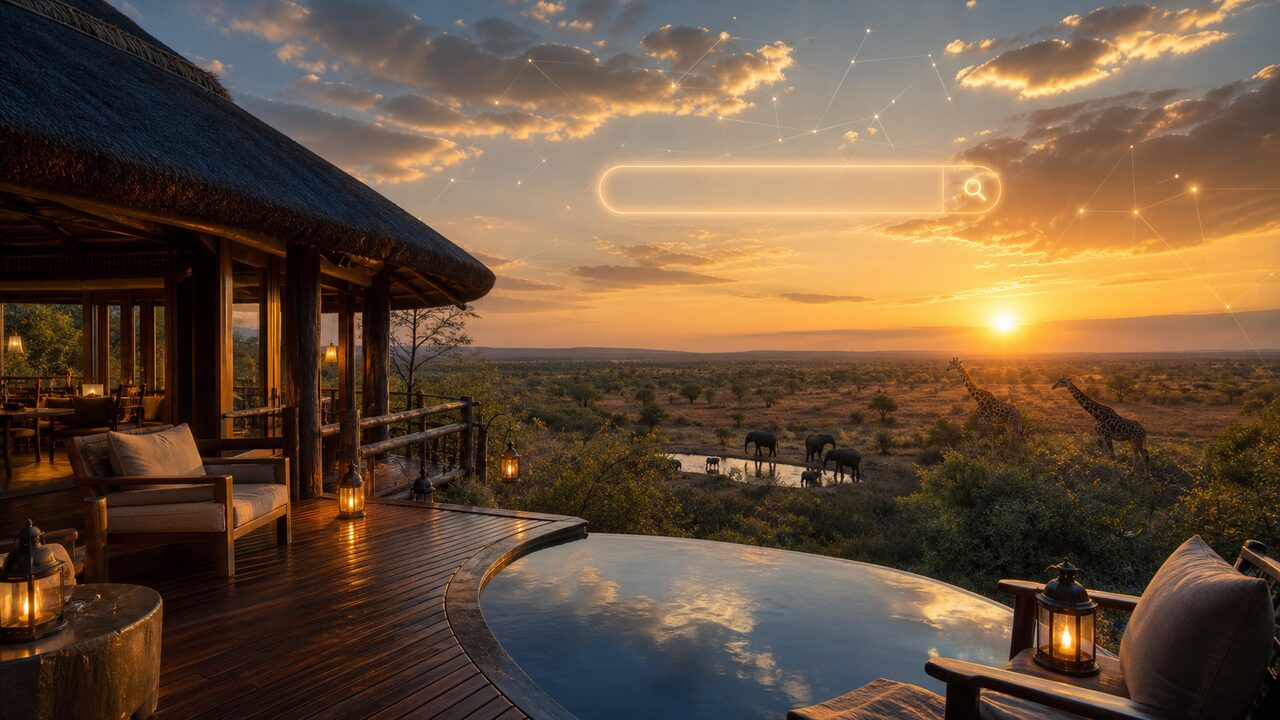
SEO for Safari Lodges in Zimbabwe - Fill More Beds From Search
A couple in London is planning the trip of a lifetime. They open Google and type 'luxury safari lodge Zimbabwe'. Within minutes they have a shortlist. The question is whether your lodge made it.
Somewhere in London, or Sydney, or New York, a couple is sitting on the sofa with a laptop between them planning the trip of a lifetime. They type "luxury safari lodge Zimbabwe" into Google. Within ten minutes they have a shortlist of three or four properties. They compare photos, read a few reviews, check availability, and enquire. The entire decision begins and often ends with that search.
If your lodge, camp or reserve was not on that first page, you were never considered. Not because your property isn't remarkable, but because it was invisible at the moment the decision was being made. This guide is written specifically for safari lodge owners and managers in Zimbabwe who want to change that.
Discuss SEO for Your Safari Lodge
Want more direct bookings from search? Speak to Craig Riley directly.
How Safari Bookings Actually Happen in 2026
The booking journey for a Zimbabwe safari has changed fundamentally over the past decade. Travellers used to rely almost entirely on specialist travel agents. Many still do, but an enormous and growing segment now researches and books independently online.
The typical path looks like this:
- Dreaming stage — searches like "best safari destinations in Africa", "Zimbabwe vs Botswana safari", "is Zimbabwe safe for tourists"
- Planning stage — "Hwange National Park lodges", "luxury tented camp Mana Pools", "walking safari Zimbabwe"
- Booking stage — "[Your Lodge Name] rates 2026", "[Your Lodge] availability September"
If your website captures traffic at the dreaming and planning stages, you are building familiarity and trust long before the guest is ready to book. If you only appear when someone already knows your name, you have missed the entire discovery window.
The Keywords That Fill Beds
Safari lodge SEO succeeds or fails on keyword strategy. The temptation is to target huge terms like "African safari", but those are dominated by global travel brands. The goldmine for a Zimbabwean lodge is in specific, high-intent phrases where you can realistically rank:
- "luxury safari lodge Zimbabwe"
- "Hwange game lodge with pool"
- "Mana Pools walking safari camp"
- "Victoria Falls safari and stay"
- "family safari Zimbabwe children"
- "Zimbabwe safari honeymoon"
- "private concession Zimbabwe bush camp"
- "best time to visit Hwange National Park"
Each of these phrases represents someone with money to spend and a decision to make. They are not browsing idly; they are planning a trip. A dedicated, well-written page that answers each of these queries will outperform a generic homepage every time. This is the same principle that drives effective SEO strategy across every industry.
Build a Page for Every Experience You Offer
Most safari lodge websites have a single "Accommodation" page and a single "Activities" page. That is not enough. Each distinct experience or room type deserves its own page if you want Google to match it to a specific search.
Consider building dedicated pages for:
- Each accommodation type — luxury suite, tented camp, family unit, honeymoon villa
- Each major activity — game drives, walking safaris, canoe safaris, birding, fishing
- Each season — "dry season safari at [Lodge]", "green season rates and wildlife"
- Nearby attractions and logistics — "how to get to Hwange from Victoria Falls", "charter flights to Mana Pools"
Each page becomes a doorway. The more specific and helpful it is, the more likely Google is to show it to the right traveller at the right time. A solid website foundation makes it easy to add and organise these pages as your content grows.
Photography Is Your SEO Superpower
No industry benefits more from visual content than safari lodges. Your photographs are not just decoration — they are a ranking asset. Google Images drives a significant share of travel research, and a well-optimised image can bring a visitor to your site who then books a stay.
To make your photography work for SEO:
- Use descriptive file names — "elephant-waterhole-hwange-lodge.jpg" not "IMG_4923.jpg"
- Write detailed alt text — "Elephant herd at the waterhole viewed from the deck at [Lodge Name], Hwange National Park"
- Compress images for fast loading without sacrificing quality, especially important for travellers researching on mobile or slower connections
- Use WebP format where possible for the best balance of quality and file size
- Add captions that tell a story, not just label the photo
Professional safari photography is something most lodges already invest in. The gap is usually that those stunning images sit unoptimised on a slow-loading page. Fix that, and they start pulling in organic traffic.
Google Business Profile for a Wilderness Property
Safari lodges often assume Google Business Profile is only for high-street businesses. It isn't. Google allows any accommodation property, including those without a traditional street address, to create a listing using map coordinates or a nearby landmark.
For a safari lodge, an optimised profile means:
- Showing up in map results when travellers search "lodges near Hwange National Park"
- Displaying reviews, photos and your star rating directly in search results
- Linking to your booking page or rates
- Providing directions and transfer information
The reviews on your Google profile are especially powerful. International travellers trust Google reviews alongside TripAdvisor, and responding to reviews (both glowing and critical) shows the kind of personal attention that sets Zimbabwean hospitality apart. This ties directly into the wider discipline of local SEO in Zimbabwe.
Direct Bookings vs OTA Commission
Online travel agents like SafariBookings, TripAdvisor, Safarigo and booking aggregators play a useful role in discovery. But every booking through those platforms comes with a commission, and the guest relationship belongs to the platform, not to you.
SEO is the long-term play for shifting the balance toward direct bookings. When a traveller finds your own website through search, you control the experience, you pay no commission, and you own the guest relationship from first click to post-stay feedback.
The smartest strategy is to use OTAs for broad exposure (especially for travellers who start there) while steadily building your own search visibility so that a growing share of enquiries come direct. Over time, the commission savings alone can justify your entire SEO investment.
Content That Sells Without Selling
The most effective content for a safari lodge is not about the lodge at all — it is about the experience, the destination and the questions a traveller has before they commit. Guides and articles that do this well include:
- "The best time to visit Hwange National Park" — seasonal wildlife guide
- "What to pack for a Zimbabwe bush safari" — practical planning help
- "Walking safari vs game drive: what to expect" — helps travellers choose
- "How to get to Mana Pools from Harare" — logistics and transfer options
- "Zimbabwe safari with kids: is it suitable?" — answers a common parental worry
Each of these pieces answers a genuine question, captures search traffic, and positions your lodge as the knowledgeable, helpful host before the guest has even arrived. By the time they are ready to book, you are already the trusted name.
Technical SEO for International Visitors
Your guests are researching from London, Sydney, Frankfurt and New York. That means your website needs to perform well for users on fast connections who expect instant load times, as well as for local agents and domestic travellers on Zimbabwean mobile data.
- Use a CDN — serving images from a content delivery network ensures fast loading regardless of the visitor's location
- Compress everything — those beautiful high-resolution gallery images need to be optimised for web without losing impact
- Mobile-first design — a significant share of safari research happens on phones during lunch breaks and evening browsing
- HTTPS is non-negotiable — a "Not Secure" warning instantly erodes trust, especially when you are asking someone to pay thousands for a stay
- Structured data — schema markup for LodgingBusiness, reviews and FAQs helps Google display rich results
Speed and security are especially critical for safari lodges because the transaction value is high. A traveller spending $500 per night per person will not tolerate a slow, clunky or insecure booking experience.
When Travellers Ask AI for Safari Recommendations
An increasingly common scenario: someone opens ChatGPT or Google's AI Overview and asks "what are the best safari lodges near Victoria Falls?" or "recommend a walking safari camp in Zimbabwe." These AI tools generate answers by drawing on the clearest, best-structured information they can find about your property.
Lodges with detailed, well-written pages covering specific experiences, clear pricing guidance, and strong review profiles are the ones AI systems confidently name. Getting ahead of this shift is what our AI Search Optimization (AEO & GEO) work addresses. The lodges that prepare now will dominate the recommendations as AI search becomes the norm for travel planning.
Measuring What Matters for a Lodge
For a safari lodge, SEO success is not about traffic volume. A page could get 200 visits a month and be incredibly valuable if those visitors are high-intent international travellers enquiring about $3,000 stays. The metrics that matter are:
- Booking enquiries and contact form submissions from organic search
- Rankings for your target destination and experience keywords
- Direct traffic share vs OTA referral traffic (is the balance shifting?)
- Which pages generate the most enquiries, not just the most views
- Google Business Profile impressions and actions (calls, direction requests, website clicks)
Track these monthly and you will see a clear picture of how search is contributing to your bottom line.
📌 Key Takeaways
- ✓International travellers start safari planning on Google — your lodge must be visible at that moment
- ✓Target specific, high-intent keywords rather than competing for broad terms like "African safari"
- ✓Build dedicated pages for each accommodation type, activity and season
- ✓Optimise your photography — it is your most powerful SEO asset in the safari industry
- ✓Google Business Profile works for wilderness properties, even without a street address
- ✓SEO drives direct bookings with no commission — the long-term alternative to OTA dependency
- ✓Destination guides and practical content capture travellers early in the planning journey
Frequently Asked Questions About SEO for Safari Lodges
Why is SEO important for safari lodges in Zimbabwe?
The vast majority of international travellers begin their safari research on Google. Terms like "luxury safari lodge Zimbabwe" and "Hwange safari camp" are searched thousands of times each month. If your property doesn't appear on page one, those bookings go to competitors who do. SEO captures high-intent travellers at the exact moment they are deciding where to stay.
How much does SEO cost for a safari lodge?
Typically $300 to $1,500 per month depending on how many properties and how broad your keyword targets are. A single lodge targeting a specific park may sit at the lower end, while a multi-property group competing for broad terms invests more. Because safari stays are high-value, even one additional direct booking per month usually exceeds the entire cost of the campaign.
How long before SEO brings bookings to my lodge?
Ranking improvements typically appear within 3 to 6 months, with meaningful booking growth from 6 to 12 months. Safari-specific keywords often have lower competition than mainstream travel terms, so well-optimised lodge sites can break through faster than expected. Timing your investment ahead of the May-to-October dry season booking window amplifies the results.
Should my lodge focus on SEO or rely on online travel agents?
Both play a role. OTAs provide broad visibility but charge commission and own the guest relationship. SEO drives direct bookings through your own website — higher margins, full guest data, and a relationship you control. The strongest approach uses OTAs for discovery while building SEO as the long-term, commission-free channel.
Can a remote lodge with no street address rank on Google Maps?
Yes. Google allows accommodation properties to use map coordinates or a nearby landmark for verification. This is common practice for wilderness lodges across Africa. The key is a complete profile with quality photos, consistent details across all directories, and an active review management strategy.
CDR Take Away
Zimbabwe's safari industry offers some of the finest wildlife experiences on the continent. The lodges, camps and reserves that will thrive in the coming years are the ones travellers can actually find. A strong search presence means being in the room, digitally, when a couple in London or a family in Sydney decides where to spend their safari budget.
The investment is modest relative to the value of a single booking, and the results compound over time. If you would like a straightforward assessment of where your lodge stands in search and what it would take to start filling more beds from Google, get in touch and we can talk it through.
Does AI recommend your business?
Find out in seconds with our free AI Visibility Checker. See whether ChatGPT and other AI assistants mention your business when customers ask — no sign-up, instant results.

About the Author
Craig RileyDigital marketing specialist with 15+ years of experience in SEO, web design, and app development. Based in Bulawayo, Zimbabwe. Also Head Coach of Water Polo at CBC Bulawayo.
Ready to Grow Your Business?
Get in touch with Craig today and let's discuss how we can help your business dominate online.