Two Methods, Very Different Trade-Offs
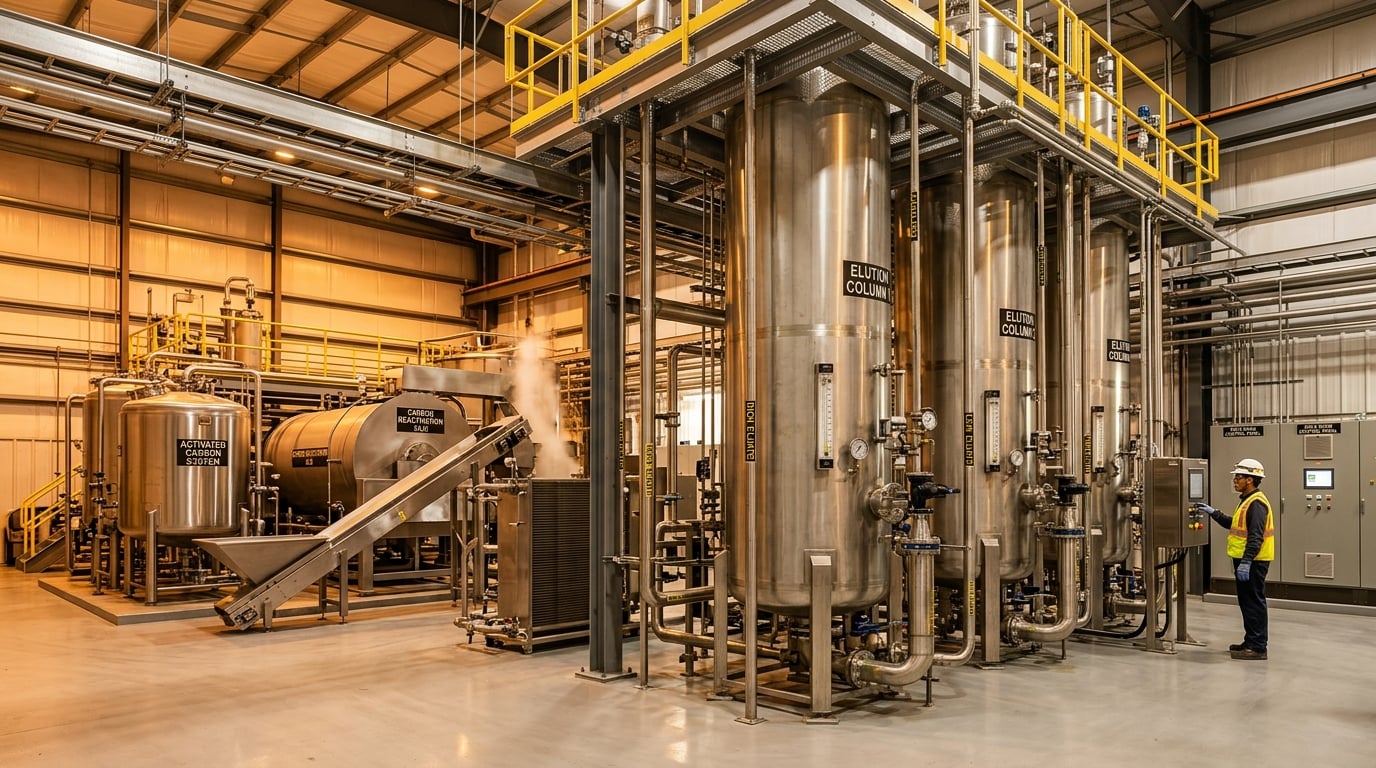
When it comes to stripping gold from loaded activated carbon, every elution plant in the world uses some variant of either the AARL (Anglo American Research Laboratories) process or the Zadra process. Both work. Both have their place. But choosing the wrong one for your specific operation can mean lower recovery rates, higher operating costs and longer cycle times.
I have worked with gold processing operations across Zimbabwe and seen first-hand how the choice of elution method impacts the bottom line. This is a practical comparison — no academic padding, just the information you need to make the right decision for your plant. If you are new to the fundamentals, start with my overview of the gold elution process.
- AARL is faster (6–10 hours) but requires more water and capital
- Zadra is slower (10–14 hours) but simpler and cheaper to set up
- AARL typically achieves higher stripping efficiency (97–99%)
- Zadra suits smaller operations; AARL suits medium-to-large mines
- Both require proper carbon management for optimal performance
The AARL Process: Fast and Thorough
The AARL method, developed by Anglo American Research Laboratories in South Africa, is a batch-based process. Here is how it works:
- Acid wash: The loaded carbon is washed with dilute hydrochloric acid (typically 3% HCl) to remove base metals — calcium, copper, magnesium — that interfere with gold desorption.
- Pre-soak: The carbon is soaked in a concentrated caustic cyanide solution (NaOH + NaCN) for 30–60 minutes. This is the critical step that differentiates AARL from Zadra — the pre-soak reverses the conditions that favour adsorption.
- Elution proper: Hot deionised water (typically 110°C at the top of the column) is passed through the carbon, washing out the gold-loaded caustic cyanide solution.
- Electrowinning: The gold-rich eluate is pumped to electrowinning cells where gold is deposited onto steel wool cathodes.
AARL Advantages
- Faster cycle time: 6–10 hours per batch
- Higher stripping efficiency: typically 97–99% gold recovery from carbon
- Better performance with high gold loadings
- Cleaner barren carbon (lower residual gold loading)
AARL Disadvantages
- Higher capital cost (deionised water plant, pressure vessel, boiler)
- Significant water consumption — requires abundant clean water supply
- More complex operation — requires skilled operators
- Higher reagent consumption (caustic soda and cyanide for pre-soak)
The Zadra Process: Simple and Reliable
The Zadra process is a continuous elution method — gold is stripped from the carbon by circulating a hot caustic cyanide solution through the elution column at atmospheric or low pressure.
Zadra Advantages
- Simpler equipment — lower capital cost
- Easier to operate — less skilled labour required
- Lower water consumption (no deionised water needed)
- Can be scaled down effectively for smaller operations
- Continuous operation means simpler scheduling
Zadra Disadvantages
- Slower: 10–14 hours per cycle (some operations report up to 24 hours)
- Lower stripping efficiency (typically 90–95%)
- Higher residual gold on barren carbon
- Less effective with very high gold loadings
Head-to-Head Comparison
| Parameter | AARL | Zadra |
|---|---|---|
| Process type | Batch | Continuous |
| Cycle time | 6–10 hours | 10–24 hours |
| Stripping efficiency | 97–99% | 90–95% |
| Capital cost | Higher | Lower |
| Water requirement | High (deionised) | Lower |
| Operator skill | Higher | Moderate |
| Temperature | 110°C (pressurised) | 95–100°C (atmospheric) |
| Best suited for | Medium to large mines | Small to medium mines |
Which Method for Zimbabwe Operations?
For most small-scale CIP and CIL operations in Zimbabwe, the Zadra process is the practical choice. Water supply is often limited, capital is constrained, and the simpler operation means fewer things can go wrong. I have seen well-run Zadra plants achieve 95%+ stripping efficiency consistently.
For medium-to-large mines with reliable water supply and skilled operators, the AARL method's faster cycle time and higher efficiency can justify the additional capital investment — especially when processing high-grade carbon with gold loadings above 5,000 g/t.
Whichever method you choose, proper carbon management (acid washing, regeneration, and avoiding poisoning) is essential for maintaining optimal performance. A perfectly designed elution circuit will underperform badly if the carbon is fouled or degraded.
Frequently Asked Questions
Can I switch from Zadra to AARL later?
Yes, but it requires significant capital investment — a deionised water plant, a pressure-rated elution column, and a boiler capable of achieving the higher temperatures. It is worth it if your operation has grown sufficiently to justify the upgrade.
What is the minimum practical scale for an AARL plant?
AARL plants become economically justified at throughputs above roughly 100 tonnes per day of ore, though this varies with gold grade. For smaller operations, see my guide on setting up a small-scale elution plant.
Why does AARL need deionised water?
The AARL process relies on deionised water to create an ionic imbalance that drives gold off the carbon. Using raw water significantly reduces stripping efficiency because dissolved minerals compete with the desorption process.
Which method has lower operating costs?
Zadra typically has lower operating costs per cycle, but AARL's faster turnaround means you can process more carbon per day. The net cost per gram of gold recovered depends heavily on your specific circumstances — gold grade, carbon loading, electricity costs and labour rates.
Need expert advice on your elution circuit? Contact Craig Riley to discuss your operation's specific requirements. Whether you need help troubleshooting existing problems or designing a new plant, I can help.