The Most Overlooked Factor in Gold Recovery
I have visited dozens of gold processing operations across Zimbabwe where the owners obsess over their elution column temperature and reagent dosing — but completely neglect their carbon. This is like maintaining your car engine while ignoring the tyres. The carbon is what carries your gold. If it is fouled, poisoned or degraded, nothing else you do matters.
Good carbon management is the difference between 95%+ recovery and watching your gold walk out with the tailings. Here is everything you need to know to keep your carbon performing at its peak.
- Acid wash every batch to remove base metals that block gold adsorption
- Regenerate at 600–650°C to burn off organic contaminants
- Monitor carbon activity regularly — do not wait for recovery to drop
- Calcium carbonate and organic fouling are the two most common killers
- Carbon fines represent real gold losses — screen and manage them
Acid Washing: The First Line of Defence
Before every elution cycle, loaded carbon should be washed with dilute hydrochloric acid — typically 3–5% HCl — for 30–60 minutes. This removes base metals (calcium, copper, magnesium, iron) that accumulate on the carbon surface and block the sites where gold adsorbs.
Why It Matters
Calcium carbonate (CaCO₃) is the single most common carbon contaminant in Zimbabwe operations. It precipitates on the carbon surface from hard process water, physically blocking adsorption sites. A properly acid-washed carbon can adsorb 2–3 times more gold per kilogram than fouled carbon.
Best Practice
- Use fresh acid solution for each batch — recycled acid is less effective
- Ensure contact time is adequate — rushing the acid wash is false economy
- Rinse thoroughly with clean water after acid washing to remove residual acid before elution
- Use an acid-resistant tank — HCl will destroy mild steel
- Dispose of spent acid solution responsibly — it contains dissolved metals and cannot be dumped
Thermal Regeneration: Restoring Carbon Activity
Even with regular acid washing, organic compounds accumulate on the carbon — oils, greases, flotation reagents, biological growth. These organics clog the internal pore structure of the carbon, reducing its surface area and gold adsorption capacity. Thermal regeneration burns them off.
The Regeneration Process
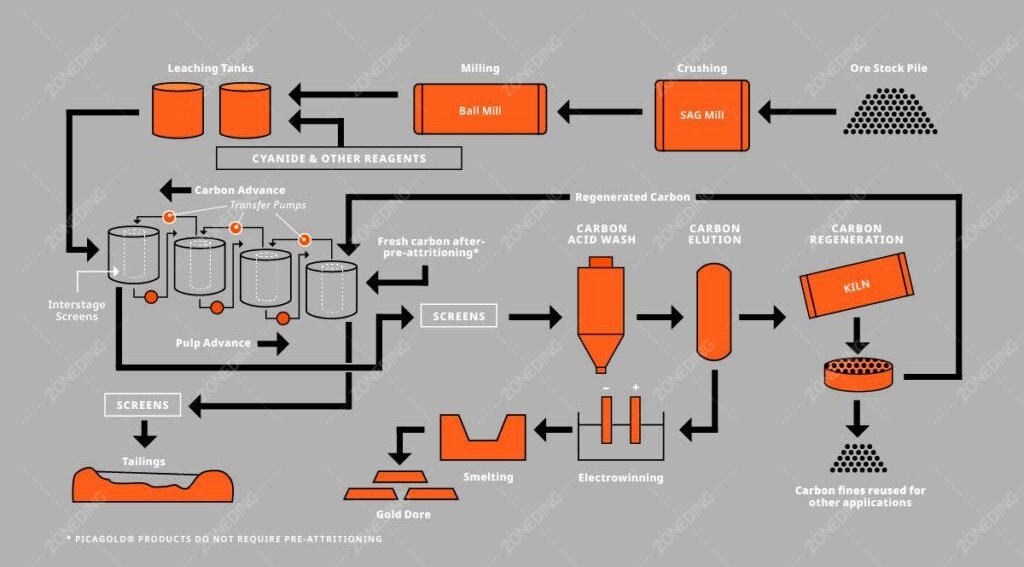
After elution, the barren carbon is fed into a rotary kiln operating at 600–650°C in a controlled atmosphere (limited oxygen to prevent carbon combustion). The residence time is typically 15–30 minutes. The heat drives off organic contaminants and restores the carbon's internal surface area.
Critical Temperature Control
- Below 550°C: Organics are not fully removed — carbon activity remains impaired
- 600–650°C: Optimal range — organics burn off, carbon structure is preserved
- Above 700°C: The carbon itself begins to oxidise, reducing particle size and mechanical strength. You are literally burning your investment
Carbon Poisoning: The Silent Killer
Carbon poisoning occurs when substances permanently deactivate adsorption sites. Unlike fouling (which can be reversed by acid washing or regeneration), severe poisoning can render carbon permanently useless.
Common Poisons
- Organic solvents and oils: Diesel contamination from equipment leaks is a frequent problem in Zimbabwe operations. Keep fuel away from your process circuit.
- Flotation reagents: If your ore passes through a flotation circuit before CIP/CIL, residual reagents can coat the carbon. Ensure thorough washing between stages.
- Silica: Fine silica particles can block pores mechanically. Proper screening of the pulp before carbon contact helps prevent this.
- Mercury: Present in some Zimbabwe ores and from artisanal mercury amalgamation operations. Mercury adsorbs onto carbon and is very difficult to remove.
Monitoring Carbon Activity
Do not wait for your gold recovery to drop before testing your carbon. Regular activity testing — at least monthly — catches problems early. The most common test measures the carbon's ability to adsorb gold from a standard solution (the "gold adsorption value" or "K-value").
Track these metrics over time:
- Gold adsorption rate (K-value) — should remain consistent cycle to cycle
- Carbon attrition rate — how much carbon you lose to fines per cycle
- Residual gold loading on barren carbon after elution — indicates elution efficiency
- Base metal loading before and after acid washing
Managing Carbon Fines
Carbon breaks down during use — abrasion in the adsorption tanks, thermal stress during regeneration, and mechanical handling all generate fine particles. These fines carry gold and represent a direct financial loss.
- Screen carbon regularly to separate fines from useable granules
- Consider a carbon fines treatment circuit to recover gold from accumulated fines
- Handle carbon gently — minimise drops, use wet transfer where possible
- Budget for carbon replacement — typical attrition is 30–50 g per tonne of ore processed
A Simple Carbon Management Checklist
- Acid wash before every elution cycle
- Regenerate after every elution cycle at 600–650°C
- Test carbon activity monthly
- Screen for fines weekly
- Log all carbon movements, weights and test results
- Replace carbon when activity drops below 80% of fresh carbon performance
- Keep diesel, oils and solvents away from the process circuit
Good carbon management is not glamorous, but it is where profitable gold recovery operations separate themselves from unprofitable ones. If you are experiencing elution problems, degraded carbon is the first thing I check.
Need help optimising your carbon circuit? Contact Craig Riley for expert guidance specific to your gold elution operation.
Frequently Asked Questions
How long does activated carbon last?
With proper management — regular acid washing, correct regeneration temperatures, and careful handling — activated carbon can last 12–24 months in a well-run circuit. Without proper care, it may degrade to the point of replacement in 3–6 months.
Can I regenerate carbon without a kiln?
Acid washing removes inorganic contaminants but does not address organic fouling. For full regeneration, you need thermal treatment at 600–650°C. Some operations use modified drum furnaces as a cost-effective alternative to purpose-built kilns.
How do I know if my carbon is poisoned or just fouled?
If activity does not recover after acid washing and proper thermal regeneration, the carbon is likely poisoned. Fresh carbon introduced to the circuit should show markedly better performance if the existing carbon is compromised.